
Oh my goodness she makes me laugh. I do not have issue with point number 6, though. Do you?
Tuesday, June 07, 2011


Friday, May 27, 2011
Making A Record
 Of all the things I do, I think being in the recording studio is my favorite. Of course, it's also the most expensive thing I do, so I don't get to do it as often as I'd like. One of the things that has most surprised me about being a grown-up professional musician is how little of your time is actually spent making music. But when I DO get to sit at a piano and play -- either into a microphone or for an audience or just for the pleasure of playing -- it's the best part.
Several months ago this musical theater friend of mine, Robert Creighton (who goes by Bobby, so I'll now start calling him Bobby), asked me if I might like to help him make his first solo album. Bobby has been in six Broadway shows (currently ANYTHING GOES) and he's written a show about Jimmy Cagney (called CAGNEY) that's getting a lot of attention. Bobby felt like if he made a record of old-fashioned songs, people would buy it. Only he didn't want the album to feel old fashioned. He wanted fresh, new arrangements of the songs that were suited to the kind of singing he most enjoys. Bobby knew that that kind of arranging is exactly what I did on my musical HELLO! MY BABY, so he asked if I'd like to do it for him, as well.
I've recorded my own debut album, and I've played on and written for a lot of other people's albums, but Bobby and I were starting from scratch. He'd say, "What if we recorded 'You Are My Sunshine?" and I'd say, "How do you hear it? Is it a ballad? Is it an uptempo? Is it a solo? A duet? Is it guitar-driven, piano-driven, rhythmic, lyrical? Is it happy? Are you singing all of the verses? What's the right key for you? Do you like the intro or should we skip it?" We did this over and over again until we had a master list of songs we liked and a template for how each of the songs might go so that the album was diverse and interesting but still felt like it all came from the same source.
It's interesting to consider that people don't really listen to records the way they used to. In 2007 when I released "This Ordinary Thursday" my record producer told me that I was the first album on their label (PSClassics) that sold more song downloads than physical copies. It used to be that you could have a hit single on one side of the vinyl and then you could put some less-good "filler" song on the B-side knowing that people would buy it just to get the hit. Nowadays, people can sample the 30-second preview of the song on iTunes, and if it's not as good as the rest of the album, they'll just skip it.
As we've been recording, I've asked Bobby to consider the order of these songs. I remember putting on a record in my room and listening to it from top to bottom. But now we listen to music in our cars, on our iPods, while we work out, and there are many more things to consider. Your first track still has to be fantastic, or people don't listen to the second track. But people who listen in their cars often get four or five songs in and then they've arrived at their destination. They might not ever get to the end of the album. And so many people just pick their favorite tunes and put them in shuffle play, so maybe it doesn't matter at all, anyway.
Unless it does. Sometimes a person will still put on a record and listen to the whole thing consecutively. Maybe they just want to sit and experience your music, top to bottom, in the order you intended. And for those people, we try to keep in mind that the best albums have flow. They have balance. The tempo, energy, key, and style of one song will lead you appropriately into the next. Great albums are conceived as great albums.
So, back in January Bobby and I recorded five songs. And last week, in late May, we recorded seven more. I flew to New York on Sunday. On Monday, we rehearsed all day, making sure we had communicated about all the ideas for the arrangements, making sure we'd thought through the performances. We talked about how singing on mic is so different from singing on stage. On the microphone, I can hear whether or not the singer is smiling. Joy can be captured in an audio performance. We rehearsed Bobby's guest singers. (They are unbelievable... but I won't spoil the announcement for him.) On Tuesday, we recorded the rhythm section - piano (me), bass, drums, and guitar. We recorded most of these things to click track (metronome) so the time would be unwavering. On Wednesday, we brought in a horn section (trumpet, trombone, sax) and recorded them as overdubs to the rhtyhm tracks we'd already recorded. On Thursday Bobby did most of his solo vocals as overdubs over the rhythm and horn charts. And on Friday, we brought in the guest vocalists and recorded them in duets (and in one case, in a barbershop quartet) with Bobby. We spent a lot of time on Thursday and Friday doing rough edits, comping together what we call a "rough mix," which means all of the layers are there, but they are not yet balanced against themselves.
So what we have now is like raw footage for a film, and now the editing begins. Next week we start mixing, or balancing the sounds. After that, there's mastering, which is the final post-production step that evens out the levels and keeps you from having to turn the volume up for one track and down for the next. And then Bobby will have photos made and a cover and a CD jacket designed. And then we'll have made a record. Simple as that.
(photo l to r is Eric Davis (guitar), Bobby Creighton, me, Larry Lelli (drums) and Randy Landau (bass))
Thursday, April 28, 2011
College MT Programs?
I've been asked to compile a list of colleges that have prominent Musical Theater programs. Basically the list should include any school that would have enough kids studying musical theater that they would book master classes, have a library of sheet music, produce a non-student-run musical, etc. Here's what I've come up with so far. What am I missing? Leave comments! Thanks!
US
Abilene Christian University (TX)
AMDA (NYC, LA)
American University (DC)
Arkansas State University (AR)
Avila University, Kansas City (MO)
Baldwin-Wallace College (Ohio)
Ball State (IN)
Bates College (ME)
Belhaven University, Jackson (MS)
Belmont University (TN)
Berklee College of Music (MA)
Birmingham Souther University (AL)
Boston Conservatory (MA)
Bowling Green State University (OH)
Brigham Young University (UT)
Brown University (RI)
CalArts (CA)
CalPoly (CA)
Cal State Fullerton (CA)
California State University Chico (CA)
CAP 21 (NY)
Capital University, Colombus (OH)
Carnegie Mellon (PA)
Catholic University (DC)
Catawba College (NC)
Central Michigan University (CMU) (MI)
Chicago College of the Performing Arts (CCPA) at Roosevelt U. (IL)
Cincinnatti Conservatory (CCM) (OH)
Clarion University (PA)
Coastal Carolina University (SC)
College of the Canyons (California)
Colombia College, Chicago (IL)
Cornerstone University, Grand Rapids (MI)
Cornish College Of The Arts (WA)
Covina Center for the Performing Arts (California)
East Carolina University (NC)
Drake University, Des Moines (IA)
Drew University (Madison, NJ)
Eastern Michigan University, Ypsilanti (MI)
Elon University (NC)
Emerson College (MA)
Fairleigh Dickinson University, Madison (NJ)
Florida Atlantic University (West Palm Beach, FL)
Florida State University (FL)
Florida International University (FL)
Harrison School for the Visual and Performing Arts (Lakeland, FL)
Hartt School of Music (CT)
Hollins University, Roanoak (VA)
Hofstra (NY)
Howard University (DC)
Hunter College (NY)
Illinois Wesleyan University (IL)
Indiana University (IN)
Ithaca College (NY)
James Madison University, Harrisonburg (VA)
The Juilliard School (NY)
Lees-McRae College (close to Boone, NC)
Liberty University (Lynchburg,VA)
Loyola University, Chicago (IL)
Manhattanville College
Marymount Manhattan (NY)
Milliken University (IL)
Middle Tennessee State Univ (TN)
Missouri State Univeersity (Springfield, MO)
Montclair State University (NJ)
Muhlenberg College (Allentown, PA)
New World School of the Arts (FL)
New York Film Academy (NY)
New York School of Film and TV (NY)
Northwestern (IL)
North Carolina School of the Arts (NC)
North Dakota State University, Fargo (ND)
Nova Southeastern Univeristy, Ft. Lauderdale (FL)
NYU (Tisch, Playwrights, Steinhardt) (NYC)
Oakland University (Rochester, Michigan)
Ohio Northern University (OH)
Oklahoma City University, OKCU (Oklahoma)
Oral Roberts University (OK)
Otterbein University (OH)
Ouchita Baptist College (AR)
Pace University (NY)
Pacific Conservatory of the Performing Arts at Allan Hancock College (CA)
Patel Conservatory, Straz Center for the PA (Tampa, FL)
Pepperdine University (Malibu, CA)
Penn State (PA)
Plymouth State University, Plymouth (NH)
Point Park University (PA)
Rockford College (IL)
Rowan University, Glassboro (NJ)
Samford Univeristy (AL)
Sam Houston State University (Texas)
San Diego State Univ (CA)
Savannah College of Art and Design (SCAD) (GA)
Seton Hill University, Greensburg (PA)
Shenandoah Conservatory (VA)
Shorter College (Rome, Georgia)
Southern Methodist University (Dallas, TX)
Suffolk University, Boston (MA)
Syracuse University (NY)
Temple (Philadelphia, PA)
Texas Chrisitian University (TX)
Texas State University (San Marcos, TX) new program
Troy University (Troy, AL)
Tulane Univ. (New Orleans, LA)
UCLA (CA)
The University of Alabama (Tuscaloosa, AL)
The University of Arizona at Tuscon (AZ)
The University of the Arts (PA)
The University of California, Irvine (CA)
The University of Central Florida (FL)
The University of Central Oklahoma (OK)
The University of Cincinnati (OH)
The University of Colorado Boulder (CO)
The University of Findlay (OH)
The University of Florida Gainesville (FL)
The University of Georgia Athens (GA)
The University of Oklahoma (OK)
The Unviersity of Maryland, College Park (MD)
The University of Memphis (TN)
The Univeristy of Miami (FL)
The University of Michigan (Ann Arbor, Michigan)
The University of Minnesota (Duluth, MN)
The University of Mississippi (MS)
The University of Missouri, Kansas City (MO)
The University of Montevallo (Montevallo, AL)
The University of N. Carolina at Chapel Hill (NC)
The University of N. Carolina Greensboro (NC)
The University of Nebraska, Lincoln (NE)
The University of North Carolina at Pembroke (NC)
The University of Northern Colorado (CO)
The University of South Florida (Tampa, FL)
The University of Southern California (USC) (CA)
The University of Southern Colorado (CO)
The University of Southern Illinois (Carbondale, IL)
The University of Southern Maine (ME)
The University of Tampa (FL)
The University of Tennessee (TN)
The University of Texas (TX)
The University of Tulsa (OK)
The University of Wisconsin at Steven's Point (Steven's Point, WI)
Valdosta State University (Valdosta, GA)
Vanderbilt University (TN)
Virginia Commonwealth University (Richmond, VA)
Viterbo College (WI)
Vassar College (Poughkeepsie, NY)
Wagner College (NY)
Weber State University (Ogden, Utah)
Webster University (MO)
West Texas A & M University, Amarillo (TX)
Western Carolina University (Cullowhee, NC)
Western Illinois University (IL)
Western Michigan University (MI)
Westminster College of the Arts at Rider University (NJ)
Wichita State University (KS)
Wright State University (OH)
Yale University (CT)
PROMINENT HIGH SCHOOLS
Booker T. Washington- Dallas
Campolindo HS- Moraga (CA)
Dreyfoos School of the Arts- Palm Beach, Fl
The Duke Ellington School (Baltimore)
Episcopal High School- Houston
Hamilton Academy of Music - Los Angeles, CA
High School of Visual and Performing Arts- Houston
Humphrey's School-TUTS- Houston, Tx
Interlochen Academy Interlochen Michigan
LACHSA - Los Angeles, CA
LaGuardia High School (NY)
NC School of the Arts High School Division- Winston-Salem, NC
New World School of the Arts- Miami
NOCCA (New Orleans Creative Center for the Arts)- New Orleans
North Carolina Theatre School Raleigh, NC
Orange County High School of the Arts (California)
Pebblebrook High School (Atlanta)
Pinellas Center for the Arts at Gibbs High School- St. Pete Fla
Stratford High School- Houston
Virginia Governor's School of the Arts- Norfolk,Va
Walnut Hill School for the Arts - Natick, MA
INTERNATIONAL SCHOOLS
The Arts Educational Schools (ArtsEd) (London) (UK)
The Australia Institute of Music (Australia)
Bird College, London (UK)
The Brit School (London) (UK)
Canadian College of Performing Arts (Victoria, Canada)
Central School of Speech and Drama (UK)
Concordia University (Montreal, Canada)
Danske Musicla Akademi (Denmark)
Dudley College (West Midlands, UK)
Griffith University (Australia)
Guildford School for Acting (UK)
Italia Conti Academy, London (UK)
Knightswood, The Danse School of Scotland (Scotland)
Laine Theatre Arts (UK)
Liverpool Institute for Performing Arts (LIPA) (UK)
London Studio Centre (London, UK)
Monash University (Australia)
Mountview Academy of Theatre Arts (London)
National Institute of Dramatic Art (NIDA) Sydney (Australia)
Performers College (London)
Randolph (Toronto, Canada)
Royal Academy of Music (London)
Royal Scottish Academy of Music and Drama (UK)
Royal Welsh College of Music and Drama (UK)
Sheridan (Ontario, Canada)
St. Lawrence College Brockville (Ontario, Canada)
Trinity Laban College of Music and Dance (UK)
The University of Ballarat (Ballarat Victoria) (Australia)
The University of British Columbia (Vancouver, Canada)
The University of Gothenburg, Academy of Music and Drama (Sweden)
The University of Toronto (Canada)
The University of Western Ontario (Canada)
The Urdang Academy (UK)
Victoria College of the Arts (Australia)
Western Australian Academy of Performing Arts (WAAPA) (Australia)
Wednesday, March 30, 2011
Musical Theatre Talk Radio Interview

Listen here to today's radio interview. Trish Causey and I talked a lot about writing, music directing, TV work, balancing motherhood and career, and plans for the future. (My part of the program starts at about 8:50.)
Thursday, March 24, 2011
Coachings: Pop/Rock
I give several private coachings each week to actors and singers who book an hour of one-on-one time in my studio. I work from the piano and guide the actors through song interpretation or vocal technique or audition prep. Each coaching is its own unique little thing, but today an actor was specifically looking for a pop/rock song. Ah, yes. That again.
Musical theater actor/singer/dancer types are being asked more and more to sing pop/rock, and often they have no idea what to do. They've spent years tap dancing and singing Rodgers and Hammerstein, Sondheim, Charles Strouse, and Ahrens and Flaherty and now they've got a big audition for one of the more pop/rock shows. (Think Spring Awakening, Next To Normal, Rent, Rock of Ages, Jersey Boys, Mamma Mia.... etc.) Actors want you to believe they can do everything, that they are malleable, versatile, skilled chameleons. Sometimes this is actually true.
But the actors who have for years relied on, well, acting, are freaked out at the idea that they will be required to stand in the middle of an audition room and sing a pop song. Here's why.
The big difference between musical theater songs and pop (radio) songs is they way they function. For the most part, a musical theater song exists to get a character from point A to point B. Over the course of the song, a character will have a realization, make a discovery, choose a direction or solve a problem, leading us from one dramatic scene to the next, keeping the show moving forward. If a musical theater song does not have direction to it, an actor has nothing to play and the show stalls. We audience members don't want that. We are sitting in the seats of the theater, waiting to see what's going to happen to our character. We are listening. We are invested. We do not want to be here all night.
A pop song, however, is usually more of an elaboration of a feeling. Pop songs are designed to be sung along with. They make you smile or they make you ache or they make you dance. If you can't sing along to the chorus by the second time you've heard it, it's probably not going to stick. So if you try to act your way through a pop song, it's likely going to be pretty awkward.
I remember one coaching where the actor asked, with earnest sincerity, "Won't you take me to... Funky Town?"
So here's the challenge. You've got to find a song that lets you rock out like a superstar on stage at Madison Square Garden, but you've also got to convince the panel that you can hold your own in a role in a musical.
I'm going to jump ahead and tell you that the answer is, and always is, you've got to figure out who YOU are when you're wearing this particular costume. In the same way that you'd expect to dig deep into your personal experience to figure out where you and Nathan Detroit meet, you've also got to find your inner rock star.
Here's what I think. I think the casting directors and the creative teams are asking you to show them what you look like when nobody else is looking. How do you sound when you're in the shower? What's on your iPod at the gym? What's in your car on a road trip? What is the music that you feel, deep in your soul? In today's coaching I asked my singer what pop music (recorded in the last ten years please, and five is better) he belted out in his car. His first two answers were Maroon 5 and Kings of Leon. So we spent some time on YouTube watching the videos of their songs, critically asking ourselves these questions.
1. Does this song have enough music in it? Is there an actual melody for me to sing? Is it going to sound decent when it's played on just a piano? Is it in my vocal range? (Or could it be if I raised or lowered it a step or two?) Is it as satisfying to sing as it is to listen to?
2. Once I cut the guitar/keyboard/bagpipe solo out of the middle, is there enough song left for me to use? Is there an obvious place to end? Is there a full song here or just a really great 16-bar cut? (Both are useful.)
3. Is the sheet music available? (Everything we found today was available for $5.25 at www.musicnotes.com.) Important: Is it in the same key as the recording? Or perhaps better still: Is it transposable into a key that's better suited for me?
4. Are any of these lyrics going to make the panel cringe? Do I believe what I'm saying? Will I be able to be authentically me when I am standing in that room, singing this song?
5. Can I sing this song without just imitating the original recording artist? Or if I DO imitate the original recording artist, do I sound awesome? (God forbid you sound like a pale imitation of the only other person we've ever heard sing this song.)
Ultimately, my client and I found a few songs today that he is going to learn, and once we've worked on them a bit he'll choose what's the most effective for him. His goal was to find the thing that would not make him feel like an idiot in the "I-don't-really riff/sing-gospel/rock/improvise" category. If we find that song -- or ideally, two contrasting songs -- we will put them in his book, right after Rodgers and Hammerstein's "If I Loved You."
And my client sings a mean "If I Loved You."
Saturday, March 19, 2011
Disney Social Media Moms Celebration 2011
 I spent Thursday and Friday participating in an amazing event. My pal Susan Egan and I were asked to be the closing event at the Disney Social Media Moms Celebration.
 Susan and I perform together often, and she has a longstanding relationship with Disney dating back to the 90s when she was the original Belle in the Broadway production of Disney's BEAUTY AND THE BEAST. (Look how gorgeous she is!) The convention was a gathering of extremely media savvy mom bloggers, and we were asked to put together an hour-long set that incorporated singing and talking on the topics of motherhood, social media, and balancing home and career. (I feel like I am both expert and novice at all of those things!)
Susan and I wondered, what on earth qualifies us to talk to this group of women? And as we sat down to build our show, here are some of the things we remembered. Susan had one of the very first websites for a Broadway actress, and I have been blogging since 2006. We are both active on Facebook and I have a busy Twitter account. (Susan now has one, as well, as the result of meeting so many inspiring women this week!) And we've done entire shows about motherhood before. (Remember our "All Knocked Up" show? Here's an interview we did as we were putting it together two years ago.)
So Sus and I put together a show that consisted of a lot of my tunes but also a lot of found material, and we yammered on quite a bit between tunes.
1. THE ME OF THE MOMENT (music and lyrics by Georgia Stitt)
Brand new song of mine, written specifically for Susan Egan about the many roles (wife, mother, performer) real women are required to play. (To be released on my next album, with Susan singing.)
2. MY LIFELONG LOVE (music and lyrics by Georgia Stitt)
A woman recounts the story of falling in love with Adam, a boy who played the clarinet. (Released on Lauren Kennedy's album "Here and Now" on PSClassics.)
3. I WON'T SAY I'M IN LOVE (from Disney's HERCULES) (music by Alan Menken, lyrics by David Zippel)
Susan's song from Hercules that her character Meg sings, sung here with the movie's animation projected on a screen behind her.
4. THIS ORDINARY THURSDAY (music and lyrics by Georgia Stitt)
Title song of my CD, about falling in love with a city and falling in love with an extraordinary man.
5. I NEVER EXPECTED THAT (music by Georgia Stitt, lyrics by David Kirshenbaum and Georgia Stitt)
Social Media song -- "The things the internet says about you/ Are there forever whatever you do..."
6. CHILDREN WILL LISTEN (music and lyrics by Stephen Sondheim)
Relevant in a new way in the context of bloggers. "Careful the things you say. Children will listen."
7. I GET TO SHOW YOU THE OCEAN (music and lyrics by Georgia Stitt)
The Cape Cod song I wrote for my daughter Molly on her first birthday. Recorded on "This Ordinary Thursday" by Faith Prince.
8. NINA DOESN'T CARE (music and lyrics by Susan Egan and Brian Haner)
Susan's original tune about how playing a princess on Broadway was a little bit different from raising a princess.
9. DEFYING GRAVITY (music and lyrics by Stephen Schwartz)
Because isn't that what we're all trying to do?
10. BEAUTY AND THE BEAST MEDLEY (music by Alan Menken, lyrics by Tim Rice)
Susan's signature Disney song, supported with backstage video from the original production.
11. MOMSENSE (based on the William Tell Overture, music by Rossini, lyrics by Anita Renfroe)
Seriously the best encore ever written.
WHILE I was on stage, I got nearly 50 new followers on Twitter, and in the days following the network continues to grow. I'm just beginning to learn about all of it, but I've got to believe that social networking like this can only contribute to sales on iTunes and www.musicnotes.com. Plus, it was great for my ego. FASCINATING.
If you're searching, my songs can be found on iTunes and the sheet music is available on www.musicnotes.com. Details for easy downloads HERE.
Thanks to all of the women (and some men, too) who made this week possible. What a treat to be included!
Tuesday, March 15, 2011
Australia, CAP21 Gala, March Update!
 So... I went to Australia.
It's kind of a crazy thing that every now and then I get to put on a dress and do a concert in a foreign country, but two weeks ago Australia got to see me do exactly that. In beautiful Brisbane (which they call Bris-Vegas for no obvious reason), I co-hosted an evening with my
 fantastically talented fellow songwriter JOHN BUCCHINO, featuring the song stylings of singers MARIKA AUBREY, ANDREW CONAGHAN, MADELINE CAIN, ANGELA HARDING, LUKE KENNEDY and TOD STRIKE. And then, less than a week (and a few master classes) later, I had a solo concert in Melbourne, adding the vocal talents of SOPHIE CARTER, AVIGAIL HERMAN, and CHRISTINA O'NEILL. My husband Jason was also on tour in Australia, and so our kids were able to come with us. Kangaroos were seen; it was a great time! Thanks to everyone who made that trip possible, especially JEREMY YOUETT of Your Management International and MEL ROBERTSON, stage manager extraordinaire.
The past few months have been jam-packed, keeping me the best kind of busy. In January HELLO! MY BABY was presented at the Goodspeed Festival of New Voices in Connecticut, and the show was a big success. We had some incredible actors from the senior classes of the Hartt School of Music (Hartford) and the Boston Conservatory, and they brought real joy and fun to the presentation.
 This past weekend we did a backer's audition in Santa Barbara, CA (see photo), and we're considering a number of possibilities for the world premiere of the show, hopefully next season. I'll certainly keep you posted here if there are announcements to be made, but if you'd like to see pictures of the show and read about its progress, find our "HELLO! MY BABY" fan page on Facebook!
In February, writing partner JOHN JILER flew out to LA and we began a major rewrite on our show BIG RED SUN. For those of you who don't live in this particular hell, writing a musical means writing a first draft and then rewriting it over and over again. The more opportunities you get to work on a show, the more you learn about it. And after the NAMT Festival last fall, we learned quite a bit. So BIG RED SUN is getting a bit of a facelift and will hopefully be ready to show off her (his? her?) fancy new smile again by the end of the summer.
And FINALLY, right around President's Day, I had an original piece of music featured on NPR. Take a look.
UPCOMING:
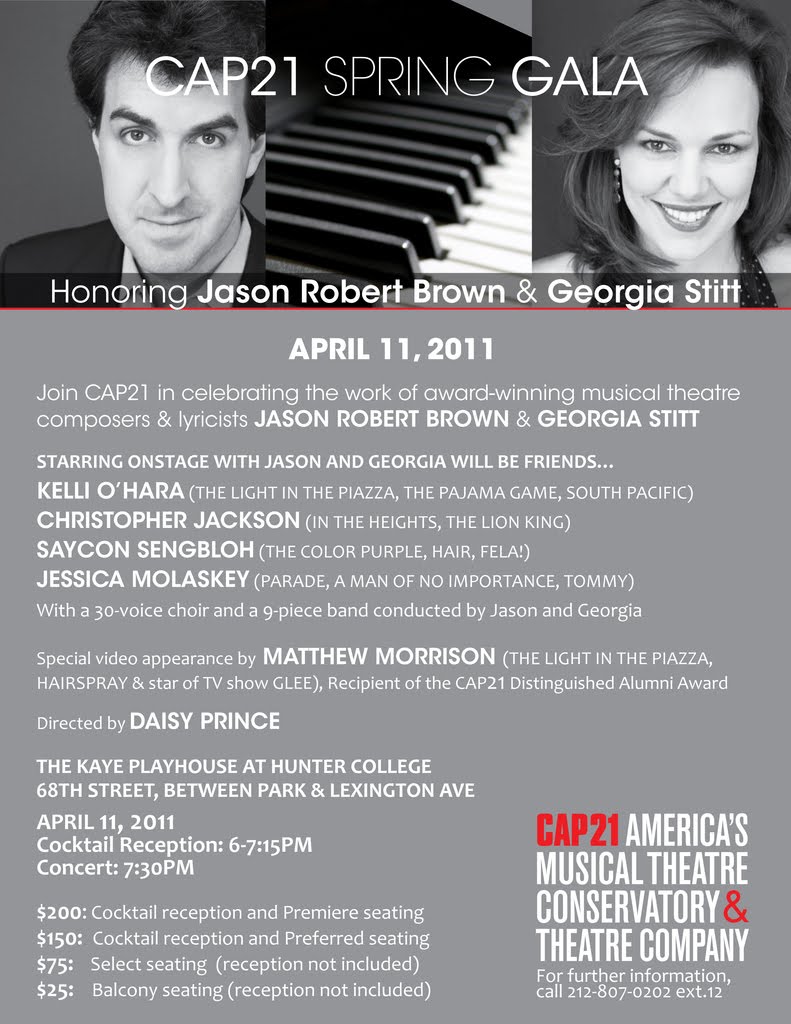
On April 11th, JASON ROBERT BROWN and GEORGIA STITT (that's me!) will be honored in a gala concert for CAP21 at the Kaye Playhouse at Hunter College in NYC. Special guests will include (this is good stuff, y'all): DAVIS GAINES, AISHA DE HAAS, CHRISTOPHER JACKSON, BRIAN d'ARCY JAMES, LAUREN KENNEDY, JESSICA MOLASKEY, KELLI O'HARA, a 30-voice choir and a nine-piece band. OH YES.
Details here:
http://www.cap21.org/gala.html
and here:
http://www.facebook.com/event.php?eid=203567582992942
Jason and I don't perform together often. This is going to be a good one. Hope to see you there!
I'm off this weekend to be the guest speaker at Disneyworld for a Celebration of SOCIAL MEDIA MOMS. I'm singing original songs (with SUSAN EGAN) and talking about Twitter. Help me look more impressive by joining Twitter just to follow me!
Thanks for reading, you guys. I remain so grateful that you are listening.
BEWARE THE IDES OF MARCH!
XO
Georgia

Thursday, March 10, 2011
Sunday, February 13, 2011
Performance Practices
My friend and fellow musician Bruce Mayhall interviewed me for a lecture on performance practices. I was so interested in the intelligence and specificity of his questions that I really took my time answering them. Read and take note, kids.
So, first: what would you say are the most significant tasks of conductors/performers in transferring your notation to realization? Do you regard the score as rather proscriptive, carefully notating what you want and expect adherence to it, or do you view it more as a skeleton to which re-creative artists add the flesh and dress? What about rhythmic or pitch ornamentation (do you permit, want it?)
A lot of my writing is style writing, meaning it's the job of the performer(s) to identify the style of the piece and adhere to the performance strictures of that style. I often write in my scores tempo and expression marking that give clues -- "in strict time" or "freely" or "with growing urgency" -- but it really does demand a lot of the performers to know whether or not this is piece that has room for embellishment. I always say to singers that if you feel the need to add notes to the ones that are already there (pitch ornamentation, riffing) you'd better have a strong acting reason that supports it. If I want the singer to riff, I use slash notation and say "vocal improvisation." Because most of my work is for the musical theater, I will always embrace the strong acting choice over the strict adherence to a detail in my score, so long as the intention of the musical gesture is intact and the style is consistent.
Do you prefer to have conductors consult you about questions they may have about interpreting your work (by either collaboration on the project, or discussions with you about specific concerns) or do you want them to bring their own best skill to the process?
I try to be accessible for questions and comments that come in through my website, but I'll confess that I'm not always able to answer every email in a timely manner. If I get the same question more than a few times I'll answer it in a post on my blog, so I recommend at least a google search before asking. Every now and then I'll hear a performance of my own material that doesn't match my intentions, and I'll wonder if I was unclear in the score or if my notations have just been ignored. I always go back to see what's actually on the page and then I try to imagine how the performer (conductor, pianist, etc.) could possibly have misinterpreted me. If I can think of a better way to express myself, I'll change the score. I am always amazed that people cannot just read my mind.
Secondly, how does vocal quality differ in Broadway performers from say, pop singers or operatic/oratorio style singing? What are the most important skills for a vocalist to develop to appropriately present your work?
Musical theater is all about the storytelling. We musical dramatists focus on expressing an idea to an audience through the use of music and lyrics. I will use a less perfect singer before I will use an unclear actor. I know in other performance styles more emphasis is put on the goal of singing something perfectly. I will emphasize singing it honestly. I'm more interested in WHY you sang that note that whether or not you approached it flawlessly. That said, if your acting choice is getting in the way of your vocal technique, that's not acceptable, either. The baseline is that you have to be able to sing well -- in tune, with accurate notes and rhythms, with intelligent musical phrasing. If you can't do that, even great acting skills won't save you. I can't bear it when a singer sings through punctuation. Trying to prove to me that you can sing a long phrase is useless if it means you've sung through two separate ideas without contemplating why there's a comma between them. I tend to direct singers often to "speak sing" a bit more, to "sing conversationally." And the key to that is knowing when to sing conversationally (in wordier, notier sections which are usually less melodic and more densely populated with lyrics, often the verse intro) and when to sing lyrically (the more melodic sections, the places that have longer notes, sweeping musical lines, climactic lyrical statements). The contrast of those two singing styles in the same piece is captivating to me. Finally, while musical theater does demand singers use their belt voices, I don't really care how high you can belt. I just need the thrilling notes to be thrilling, the loud places to be loud, and the moments with the highest stakes to be supported. Usually that's a belt, but if you can convince me of it otherwise, go for it. But make sure you're singing musically and that belt has a contrast somewhere else in the song. You do not want your audience to be fatigued because you're singing loud and high the whole song. Boring.
What instrumental combinations are best for your work? Live players and acoustic, traditional instruments - and/or synthesized, programmed computerized sound, and/or electrified instruments? Do you orchestrate your own work?
I write for acoustic instruments, with only a very few exceptions. I do orchestrate my own work but I have also worked with other orchestrators. The size of the pit orchestra is determined in balance by the needs of the show (is it a rock & roll score? a swing big band? a contemporary guitar-based pop sound?) and the budget of the producers. At the Broadway level there are union rules determining the minimum number of musicians you can use in a show. I tend to believe the more musicians you can get, the better. I have played synth in pit orchestras and yet I'd still rather have a live harp than a synthesized one any day. I'm a bit of a traditionalist.
Tempo: do you mark M. M. = ; or do you use objective/subjective words to convey your tempos? Is tempo fluctuation desireable (according to emotional content of the text? or other factors?), or do you (again) specify in your score and expect conformity?
Both. I do use M.M = and I often couple it with descriptive words. Tempo fluctuation, again, completely depends on the style of the piece. A lot of theater and pop writing is groove-driven. If that's the case, then no, tempo variation is awful. Often in master classes my first wish is that I could turn on a metronome and make the pianist keep better time. The pianist's job is to provide a bed of support for the singers, and if the pianist isn't keeping steady time, how can the singer possibly make appropriate choices, sing syncopations accurately, or put an accent on a downbeat? But then if the piece calls for rubato playing, I very much want the performers to make expressive and musical choices. I try to notate the difference as often as possible but I also expect the performers to understand the style of music they have chosen to perform.
Rhythms: do you notate "swung" rhythm or would you expect (as in pop and jazz notations) performers to understand what is appropriate to your style?
In theater it is standard to notate swing rhythms as eighth notes and then write a parenthetical comment ("swung eighths") at the beginning of the section. I have also seen dotted rhythms (dotted eighth/sixteenth) used to denote "swing" time, but rarely do I see swung things written out in 12/8, as would be most accurate. I usually prefer to notate the rhythms as straight eighths with written commentary, and I try to be consistent in style for the entire piece.
What are any other aspects of performance practice are of concern to you?
Vibrato should be natural. Dynamics are not arbitrary. And finally, the most thrilling performances of my pieces are the ones that teach me something I didn't know about the song. Find the place where the truth of the song and the truth of the performer meet. If it feels false to you, it probably is.
Friday, February 04, 2011
Subscribe to:
Posts (Atom)


 Posts

