Saturday, March 19, 2011

Disney Social Media Moms Celebration 2011

I spent Thursday and Friday participating in an amazing event. My pal Susan Egan and I were asked to be the closing event at the Disney Social Media Moms Celebration. Susan and I perform together often, and she has a longstanding relationship with Disney dating back to the 90s when she was the original Belle in the Broadway production of Disney's BEAUTY AND THE BEAST. (Look how gorgeous she is!) The convention was a gathering of extremely media savvy mom bloggers, and we were asked to put together an hour-long set that incorporated singing and talking on the topics of motherhood, social media, and balancing home and career. (I feel like I am both expert and novice at all of those things!)

Susan and I wondered, what on earth qualifies us to talk to this group of women? And as we sat down to build our show, here are some of the things we remembered. Susan had one of the very first websites for a Broadway actress, and I have been blogging since 2006. We are both active on Facebook and I have a busy Twitter account. (Susan now has one, as well, as the result of meeting so many inspiring women this week!) And we've done entire shows about motherhood before. (Remember our "All Knocked Up" show? Here's an interview we did as we were putting it together two years ago.)

So Sus and I put together a show that consisted of a lot of my tunes but also a lot of found material, and we yammered on quite a bit between tunes.

1. THE ME OF THE MOMENT (music and lyrics by Georgia Stitt)
Brand new song of mine, written specifically for Susan Egan about the many roles (wife, mother, performer) real women are required to play. (To be released on my next album, with Susan singing.)

2. MY LIFELONG LOVE (music and lyrics by Georgia Stitt)
A woman recounts the story of falling in love with Adam, a boy who played the clarinet. (Released on Lauren Kennedy's album "Here and Now" on PSClassics.)

3. I WON'T SAY I'M IN LOVE (from Disney's HERCULES) (music by Alan Menken, lyrics by David Zippel)
Susan's song from Hercules that her character Meg sings, sung here with the movie's animation projected on a screen behind her.

4. THIS ORDINARY THURSDAY (music and lyrics by Georgia Stitt)
Title song of my CD, about falling in love with a city and falling in love with an extraordinary man.

5. I NEVER EXPECTED THAT (music by Georgia Stitt, lyrics by David Kirshenbaum and Georgia Stitt)
Social Media song -- "The things the internet says about you/ Are there forever whatever you do..."

6. CHILDREN WILL LISTEN (music and lyrics by Stephen Sondheim)
Relevant in a new way in the context of bloggers. "Careful the things you say. Children will listen."

7. I GET TO SHOW YOU THE OCEAN (music and lyrics by Georgia Stitt)
The Cape Cod song I wrote for my daughter Molly on her first birthday. Recorded on "This Ordinary Thursday" by Faith Prince.

8. NINA DOESN'T CARE (music and lyrics by Susan Egan and Brian Haner)
Susan's original tune about how playing a princess on Broadway was a little bit different from raising a princess.

9. DEFYING GRAVITY (music and lyrics by Stephen Schwartz)
Because isn't that what we're all trying to do?

10. BEAUTY AND THE BEAST MEDLEY (music by Alan Menken, lyrics by Tim Rice)
Susan's signature Disney song, supported with backstage video from the original production.

11. MOMSENSE (based on the William Tell Overture, music by Rossini, lyrics by Anita Renfroe)
Seriously the best encore ever written.

WHILE I was on stage, I got nearly 50 new followers on Twitter, and in the days following the network continues to grow. I'm just beginning to learn about all of it, but I've got to believe that social networking like this can only contribute to sales on iTunes and www.musicnotes.com. Plus, it was great for my ego. FASCINATING.

If you're searching, my songs can be found on iTunes and the sheet music is available on www.musicnotes.com. Details for easy downloads HERE.

Thanks to all of the women (and some men, too) who made this week possible. What a treat to be included!

Tuesday, March 15, 2011

Australia, CAP21 Gala, March Update!

So... I went to Australia.

It's kind of a crazy thing that every now and then I get to put on a dress and do a concert in a foreign country, but two weeks ago Australia got to see me do exactly that. In beautiful Brisbane (which they call Bris-Vegas for no obvious reason), I co-hosted an evening with my fantastically talented fellow songwriter JOHN BUCCHINO, featuring the song stylings of singers MARIKA AUBREY, ANDREW CONAGHAN, MADELINE CAIN, ANGELA HARDING, LUKE KENNEDY and TOD STRIKE. And then, less than a week (and a few master classes) later, I had a solo concert in Melbourne, adding the vocal talents of SOPHIE CARTER, AVIGAIL HERMAN, and CHRISTINA O'NEILL. My husband Jason was also on tour in Australia, and so our kids were able to come with us. Kangaroos were seen; it was a great time! Thanks to everyone who made that trip possible, especially JEREMY YOUETT of Your Management International and MEL ROBERTSON, stage manager extraordinaire.

The past few months have been jam-packed, keeping me the best kind of busy. In January HELLO! MY BABY was presented at the Goodspeed Festival of New Voices in Connecticut, and the show was a big success. We had some incredible actors from the senior classes of the Hartt School of Music (Hartford) and the Boston Conservatory, and they brought real joy and fun to the presentation. This past weekend we did a backer's audition in Santa Barbara, CA (see photo), and we're considering a number of possibilities for the world premiere of the show, hopefully next season. I'll certainly keep you posted here if there are announcements to be made, but if you'd like to see pictures of the show and read about its progress, find our "HELLO! MY BABY" fan page on Facebook!

In February, writing partner JOHN JILER flew out to LA and we began a major rewrite on our show BIG RED SUN. For those of you who don't live in this particular hell, writing a musical means writing a first draft and then rewriting it over and over again. The more opportunities you get to work on a show, the more you learn about it. And after the NAMT Festival last fall, we learned quite a bit. So BIG RED SUN is getting a bit of a facelift and will hopefully be ready to show off her (his? her?) fancy new smile again by the end of the summer.

And FINALLY, right around President's Day, I had an original piece of music featured on NPR. Take a look.

UPCOMING:
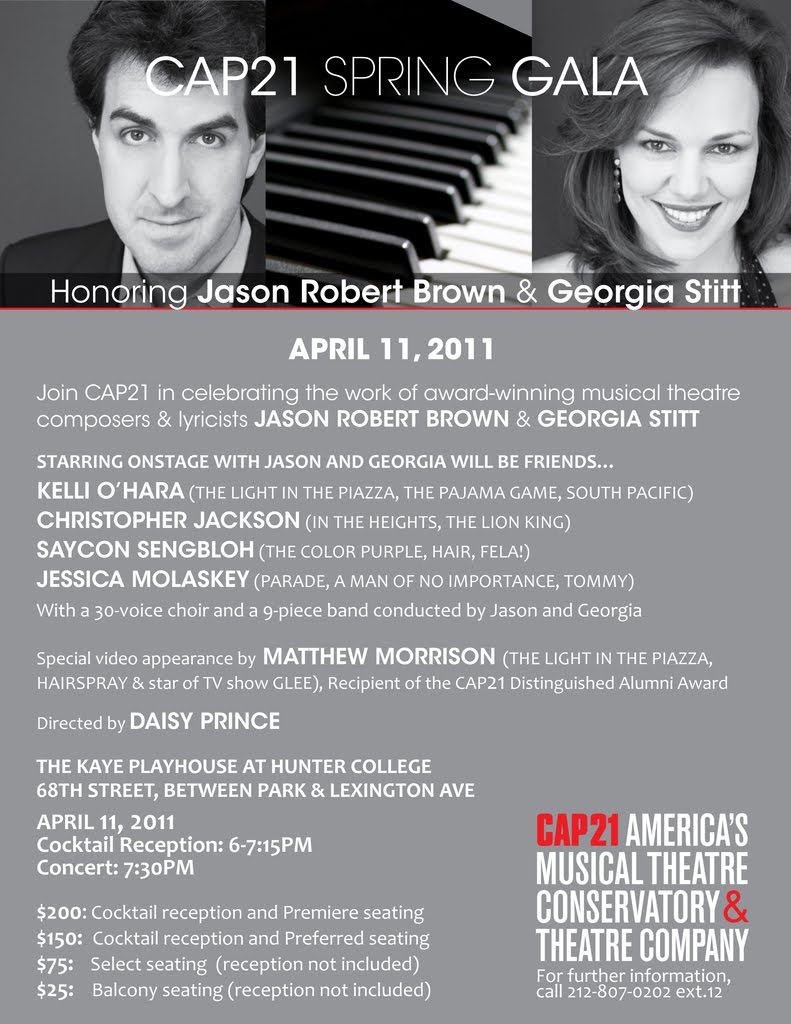
On April 11th, JASON ROBERT BROWN and GEORGIA STITT (that's me!) will be honored in a gala concert for CAP21 at the Kaye Playhouse at Hunter College in NYC. Special guests will include (this is good stuff, y'all): DAVIS GAINES, AISHA DE HAAS, CHRISTOPHER JACKSON, BRIAN d'ARCY JAMES, LAUREN KENNEDY, JESSICA MOLASKEY, KELLI O'HARA, a 30-voice choir and a nine-piece band. OH YES.

Details here:
http://www.cap21.org/gala.html

and here:
http://www.facebook.com/event.php?eid=203567582992942

Jason and I don't perform together often. This is going to be a good one. Hope to see you there!

I'm off this weekend to be the guest speaker at Disneyworld for a Celebration of SOCIAL MEDIA MOMS. I'm singing original songs (with SUSAN EGAN) and talking about Twitter. Help me look more impressive by joining Twitter just to follow me!

Thanks for reading, you guys. I remain so grateful that you are listening.

BEWARE THE IDES OF MARCH!

XO
Georgia

Sunday, February 13, 2011

Performance Practices

My friend and fellow musician Bruce Mayhall interviewed me for a lecture on performance practices. I was so interested in the intelligence and specificity of his questions that I really took my time answering them. Read and take note, kids.

So, first: what would you say are the most significant tasks of conductors/performers in transferring your notation to realization? Do you regard the score as rather proscriptive, carefully notating what you want and expect adherence to it, or do you view it more as a skeleton to which re-creative artists add the flesh and dress? What about rhythmic or pitch ornamentation (do you permit, want it?)

A lot of my writing is style writing, meaning it's the job of the performer(s) to identify the style of the piece and adhere to the performance strictures of that style. I often write in my scores tempo and expression marking that give clues -- "in strict time" or "freely" or "with growing urgency" -- but it really does demand a lot of the performers to know whether or not this is piece that has room for embellishment. I always say to singers that if you feel the need to add notes to the ones that are already there (pitch ornamentation, riffing) you'd better have a strong acting reason that supports it. If I want the singer to riff, I use slash notation and say "vocal improvisation." Because most of my work is for the musical theater, I will always embrace the strong acting choice over the strict adherence to a detail in my score, so long as the intention of the musical gesture is intact and the style is consistent.

Do you prefer to have conductors consult you about questions they may have about interpreting your work (by either collaboration on the project, or discussions with you about specific concerns) or do you want them to bring their own best skill to the process?

I try to be accessible for questions and comments that come in through my website, but I'll confess that I'm not always able to answer every email in a timely manner. If I get the same question more than a few times I'll answer it in a post on my blog, so I recommend at least a google search before asking. Every now and then I'll hear a performance of my own material that doesn't match my intentions, and I'll wonder if I was unclear in the score or if my notations have just been ignored. I always go back to see what's actually on the page and then I try to imagine how the performer (conductor, pianist, etc.) could possibly have misinterpreted me. If I can think of a better way to express myself, I'll change the score. I am always amazed that people cannot just read my mind.

Secondly, how does vocal quality differ in Broadway performers from say, pop singers or operatic/oratorio style singing? What are the most important skills for a vocalist to develop to appropriately present your work?

Musical theater is all about the storytelling. We musical dramatists focus on expressing an idea to an audience through the use of music and lyrics. I will use a less perfect singer before I will use an unclear actor. I know in other performance styles more emphasis is put on the goal of singing something perfectly. I will emphasize singing it honestly. I'm more interested in WHY you sang that note that whether or not you approached it flawlessly. That said, if your acting choice is getting in the way of your vocal technique, that's not acceptable, either. The baseline is that you have to be able to sing well -- in tune, with accurate notes and rhythms, with intelligent musical phrasing. If you can't do that, even great acting skills won't save you. I can't bear it when a singer sings through punctuation. Trying to prove to me that you can sing a long phrase is useless if it means you've sung through two separate ideas without contemplating why there's a comma between them. I tend to direct singers often to "speak sing" a bit more, to "sing conversationally." And the key to that is knowing when to sing conversationally (in wordier, notier sections which are usually less melodic and more densely populated with lyrics, often the verse intro) and when to sing lyrically (the more melodic sections, the places that have longer notes, sweeping musical lines, climactic lyrical statements). The contrast of those two singing styles in the same piece is captivating to me. Finally, while musical theater does demand singers use their belt voices, I don't really care how high you can belt. I just need the thrilling notes to be thrilling, the loud places to be loud, and the moments with the highest stakes to be supported. Usually that's a belt, but if you can convince me of it otherwise, go for it. But make sure you're singing musically and that belt has a contrast somewhere else in the song. You do not want your audience to be fatigued because you're singing loud and high the whole song. Boring.


What instrumental combinations are best for your work? Live players and acoustic, traditional instruments - and/or synthesized, programmed computerized sound, and/or electrified instruments? Do you orchestrate your own work?

I write for acoustic instruments, with only a very few exceptions. I do orchestrate my own work but I have also worked with other orchestrators. The size of the pit orchestra is determined in balance by the needs of the show (is it a rock & roll score? a swing big band? a contemporary guitar-based pop sound?) and the budget of the producers. At the Broadway level there are union rules determining the minimum number of musicians you can use in a show. I tend to believe the more musicians you can get, the better. I have played synth in pit orchestras and yet I'd still rather have a live harp than a synthesized one any day. I'm a bit of a traditionalist.

Tempo: do you mark M. M. = ; or do you use objective/subjective words to convey your tempos? Is tempo fluctuation desireable (according to emotional content of the text? or other factors?), or do you (again) specify in your score and expect conformity?

Both. I do use M.M = and I often couple it with descriptive words. Tempo fluctuation, again, completely depends on the style of the piece. A lot of theater and pop writing is groove-driven. If that's the case, then no, tempo variation is awful. Often in master classes my first wish is that I could turn on a metronome and make the pianist keep better time. The pianist's job is to provide a bed of support for the singers, and if the pianist isn't keeping steady time, how can the singer possibly make appropriate choices, sing syncopations accurately, or put an accent on a downbeat? But then if the piece calls for rubato playing, I very much want the performers to make expressive and musical choices. I try to notate the difference as often as possible but I also expect the performers to understand the style of music they have chosen to perform.

Rhythms: do you notate "swung" rhythm or would you expect (as in pop and jazz notations) performers to understand what is appropriate to your style?

In theater it is standard to notate swing rhythms as eighth notes and then write a parenthetical comment ("swung eighths") at the beginning of the section. I have also seen dotted rhythms (dotted eighth/sixteenth) used to denote "swing" time, but rarely do I see swung things written out in 12/8, as would be most accurate. I usually prefer to notate the rhythms as straight eighths with written commentary, and I try to be consistent in style for the entire piece.

What are any other aspects of performance practice are of concern to you?

Vibrato should be natural. Dynamics are not arbitrary. And finally, the most thrilling performances of my pieces are the ones that teach me something I didn't know about the song. Find the place where the truth of the song and the truth of the performer meet. If it feels false to you, it probably is.

Monday, January 24, 2011

Thanks for purchasing sheet music!

Hey, guys. I just wanted to take a moment to thank those of you who have made the effort to find and purchase sheet music instead of downloading it illegally. I know it's a question of ethics and many of you are making a huge difference in the lives of the composers and lyricists you support. This report is very encouraging. Thanks!!

Australia Concerts in March

GEORGIA STITT CONCERT DATES:
BRISBANE - John Bucchino, Georgia Stitt and Friends in Concert
Brisbane (with John Bucchino) - Wednesday March 2
QLD Conservatorium Theatre
7.30pm
in association with Harvest Rain
Info/Tickets:
http://www.qtix.com.au/

MELBOURNE - Georgia Stitt and Friends in Concert
With Andrew Conaghan, Tod Strike, Madeline Cain, Sophie Carter, Chrissy O'Neill and Avigail Herman
Melbourne - Sunday March 6
Bennetts Lane
7.30pm
Info/Tickets:
$35 Advance Sales / $40 At the door
Moshtix
W: www.moshtix.com.au
Ph: 1300 GET TIX (438 849)


Visit:
www.yourmanagement.biz
for more information!

Monday, December 13, 2010

A Master Class for the Writer

A few months ago I was teaching a musical theater master class in New York City, and one of my actors said, "I hope it's okay -- I'd like to sing one of YOUR songs."

Members of my family have asked me what a master class is, and for those of you who don't regularly make a practice of studying musical theater, I'll fill you in. A master class is an organized class where a "master" teacher (in this case, me... yes, I know... ) works one-on-one with an individual student while the rest of the students (and often, faculty) watch. The process is obviously beneficial to the guinea pig student getting the private attention, but it's also helpful to the crowd of onlookers, most of whom are able to absorb some bit of advice or wisdom from watching the process happen in front of them.

I teach master classes at colleges pretty regularly, and usually the students bring in standard musical theater repertoire. I work mostly on song interpretation. I ask a lot of questions. (What does this lyric mean? Who are you talking to? What are you trying to accomplish? Why do you think there's suddenly a minor chord on that particular word? What does the ascending line of the melody tell you about your character's emotional life? What happens if you sing that entire line in one breath?) Because I'm a writer, I try to make the actors question why the composers and lyricists made the decisions they made, and I encourage the actors to make musical and dramatic choices to support their understanding of the text.

Every once in a while, I'll get asked to teach a master class in which the students all have to sing music that I wrote. I love the classics, but I have to admit that my ego and I really like it when the songs are mine. Never have I made it through a class without learning something about one of my songs from the insight and individuality of the actor singing it.

So, on this particular day, an actor put down in front of the pianist a piece of music that I've never released to the public. As you know, I sell a lot of my sheet music, in both hard copy and digital formats, but this guy had a photocopy of a piece of music that I had used in an early reading of my show THE WATER. And that music isn't for sale anywhere. So immediately I knew that the music was a bootleg. I have to assume that one of the actors or stage managers or musicians from one of the early readings of my show made a copy of that score and, without my permission, circulated it.

So.. you know me. I launched into my copyright speech. And the actor was shocked. He had no idea I would be upset. He had just gotten this music from his coach and he'd gone and memorized it. He had really meant to honor me by choosing this song. It was totally not his fault. So I allowed him to work on it -- and that's where the trouble really started.

You see, this music was so old that it didn't reflect the changes we'd made to the second act, where this very song occurs. In the version of the song this guy had, his character proposed to his girlfriend, and at the end of the song, she turned him down. But in the rewrite of the show, the girlfriend now says yes. There's a whole new ending to the song, because we discovered in that first reading that the sad version didn't work. And now here this actor was, in my master class, asking me to help him make sense of a song that actually doesn't even exist anymore.

So first of all, I was embarrassed. Because there my name is on the title page of the song, and I'm watching all these details go by and I'm thinking, "Yeah, we fixed that." "Whew, that was a bad lyric." "Oh, I forgot about those extra bars there because we cut them." And so on. But second of all, and more importantly, I was annoyed that this piece of music is out in the world. Because I didn't release it. That's exactly why I wait until things are finished to make them available to the public. And sometimes it takes a very long time for a song to be finished.

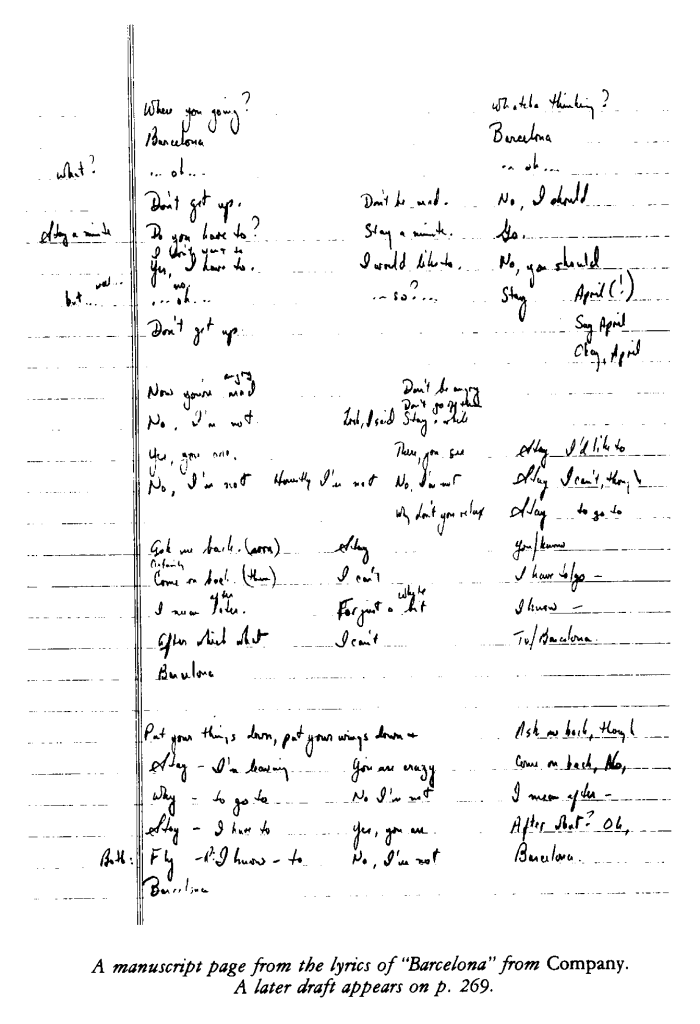
There is a novelty, especially among students and collectors, to having early drafts of works. It's fun to see the notepads where lyricists wrote their first drafts of now-famous lyrics. But what's good for a collector is not necessarily good for an actor. I may not have known in my first draft of that song that it was a bad idea. That's the process of writing and rewriting, which is what writers spend all day every day trying to get right. It is to your best advantage, as the performer, to have the version of the song that actually works.

Actors must have the ability to be critical thinkers. In master classes, I often tell students that trying to find the song that nobody else is singing isn't necessarily a great idea. The best songs -- both contemporary and traditional -- are the ones that have withstood the test of time. They have survived the scrutiny of many different kinds of singers. Uncovering the song that nobody knows may not set you apart because of your incredible research. It may set you apart because you sang something -- maybe even something of mine -- that wasn't any good.

Friday, September 24, 2010

BIG RED SUN prepares for NAMT

I'm pretty excited to announce that my show BIG RED SUN has been chosen to be featured in the National Alliance for Musical Theater's Festival of New Musicals this fall. I'm told that about four hundred shows applied and they chose eight, so I'm thrilled. That was bragging, wasn't it? Whoops. Sorry.

Regular readers of this blog (both of you -- Hi, Mom and Dad) will recall that a year and a half ago BIG RED SUN was part of the Oklahoma City University festival called OCUStripped. And that's the last time I wrote about it. Since then we've made new demos (all featured here on the show's website), edited down a 45-minute version of the show for the festival, hired a fantastic cast, director, & music director, and now I'm orchestrating the whole darn thing for piano, bass, drums, and a reed player. Rehearsals start in a few weeks and we have two presentations at the end of October. If you're INDUSTRY (defined as: “someone who is an entertainment professional who can aid in the advancement of the musicals being presented or the writer’s careers”) you can get a ticket here. And if you're interested in the show, you can write my manager Bruce Miller to get all the materials (script/demo/production specs) for your consideration. Everyone else, please enjoy the demos and watch this space for information about what comes next.

Click here to hear the closing number, cleverly titled: "Big Red Sun."

BIG RED SUN (Harry, Helen, Eddie and ensemble)
Singers: Daniel Tatar, Melissa Lyons, Jason Robert Brown, Katie Von Till, Lizzie Weiss, Dan Callaway, Jay Donnell
Piano: Georgia Stitt; Bass: Tim Christensen; Drums: Tom Walsh; Guitars: George Doering and Kevin Dukes